

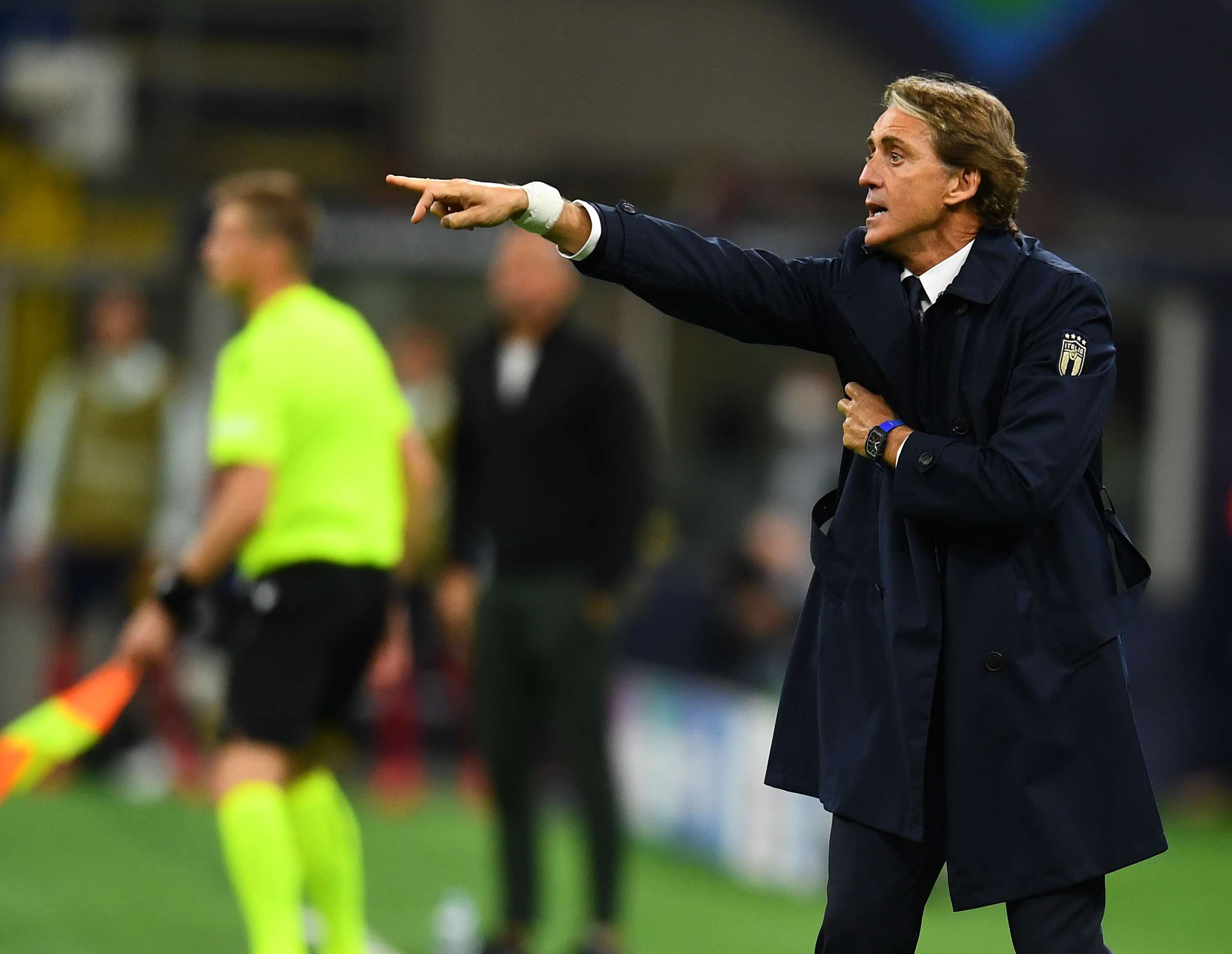
The last few days in Italian football have resembled a trademark sense of chaos. To many, this isn’t new but to some regular on-lookers, the pandemonium reached a different level altogether, as FIGC vetoed against Andrea Pirlo’s appointment, leading to Paolo Maldini’s exit and now Roberto Mancini’s appointment as manager.
The ex-Manchester City manager was the FIGC majority’s choice all along, having previously guided them to the European Championships win in 2021. Besides, the relationship between the two parties remains good, with new president Giovanni Malago always being a backer of the manager. It is safe to say that from the perspective of what he has done in recent years for the national team, Mancini comes in as a safe appointment but he may not be the best one.
If anything, the 61-year-old is a fail safe in the current scenario. He is that safety net you can call upon to do a job and he could well the job fairly well. At the Euros in 2021, his tactical setup brought the most out of a lot of players in the side and in a way, that is what international football is about too. Moreover, Italian football has always been fraught with politics – particularly the Azzurri job.
But truth be told, many at FIGC expected a major change in the footballing setup right after the disaster of failing to qualify for the World Cup. Hiring Mancini – after all the promises, seems fairly off-putting.
His arrival won’t bring about a major change in the entire setup; at least not the sort of change that was needed. He could do a decent job too and get some results but it may not be a big step for Italian football. Standards for the Azzurri are low, after. A World Cup qualification could well be celebrated but with Mancini, the next step won’t really arrive.
A structural change needs transformation from the top and one that filters to the bottom. That is what Italian needs. There is a lack of identity which sets them apart from the rest of the nations and that holds them back constantly, as Italy fail to take control of games when needed. Games float and Azzurri teams fall back into a shell when they can easily do the opposite. That lack of risk-taking ability reflects itself everywhere. Granted, it worked decades ago but it won’t anymore.
In a way, it also mirrors many appointments made at club level. Italian football and Serie A is now mocked for recycling the same managers across the big clubs and Mancini himself has seen that. Even there, a lack of risk-taking is constantly prevalent and even there, problems are bigger than managerial appointments.
But promises were made when Malago was appointed and a raft of departures took place after the disaster in Bosnia. Despite that, the route taken is largely familiar – annoyingly enough.
It is fair to say the likes of Thiago Motta and Raffaele Palladino may not have been perfect for the job. But no one really is at this point. The best of Italian ideas have been taken to other countries, making a managerial appointment generally difficult. But an appointment of a Motta or Palladino would have sent a message. It would have screamed that Calcio is prepared to go down a new route.
There have been concerns about Motta’s teams in-possession and about Palladino’s constant chopping and changing of systems. But these are managers who could have – more than Mancini, have brought about new ideas to the national team. They have done that at club level to some extent and remain much more in-tune with where the game is going.
Granted, they’re not the Roberto De Zerbis or the Francesco Fariolis of this world. They’re not Arrigo Sacchis either and they won’t win you a major international tournament – potentially. But where Italian football is right now, it needed a statement. An indication that things are different. But that is where it has met failure. Again.
Kaustubh Pandey – GIFN