


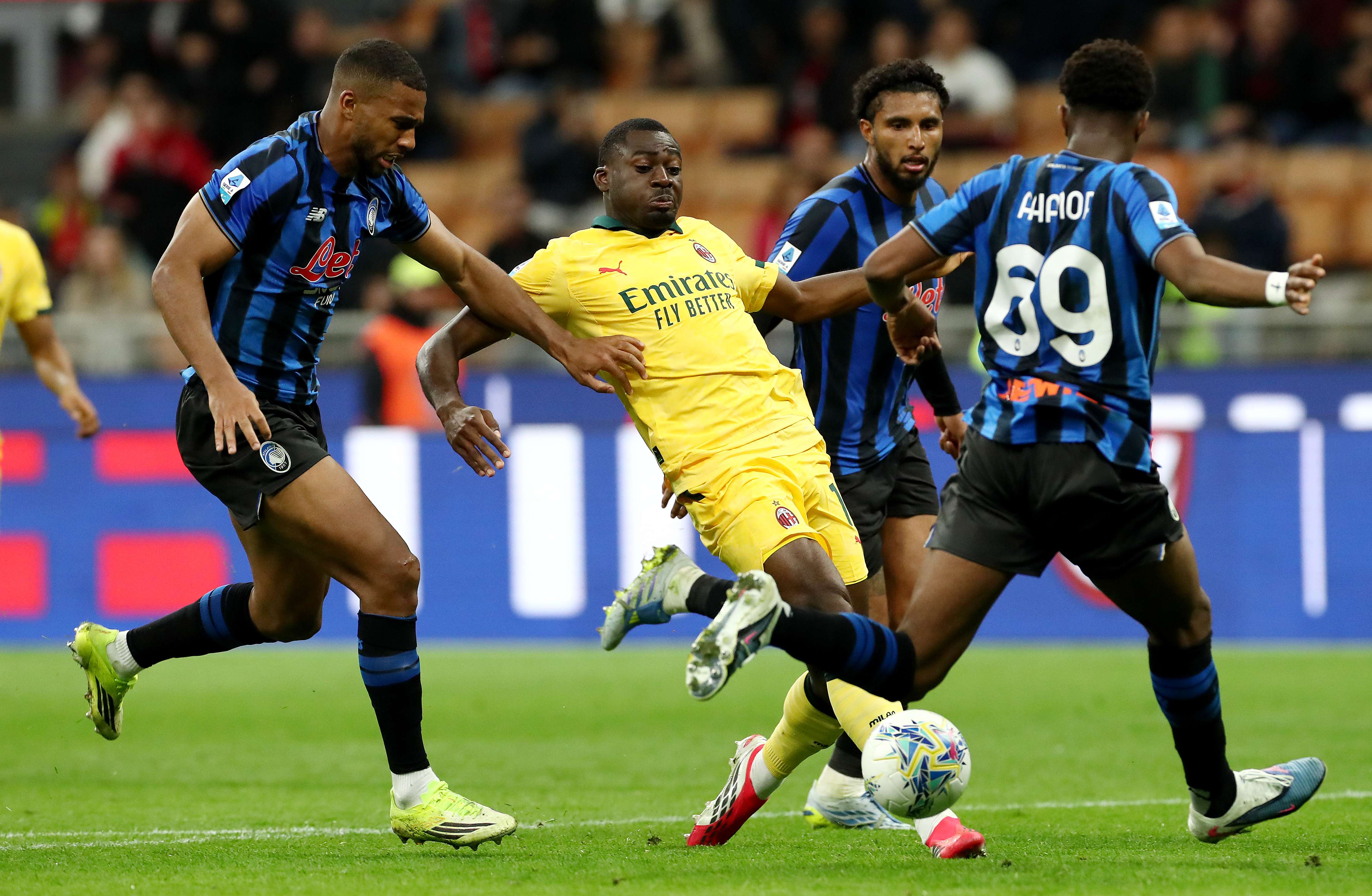
Coming off a brutal campaign last season in which La Dea finished in 7th place, missing out of Europa League football, Atalanta managed to start this year’s season with a strong footing.
Following the appointment of former Lazio coach Maurizio Sarri, as well as a very active transfer market, Atalanta managed to secure six out of nine points available within the opening three matches of the leage with two consecutive wins against Sassuolo and Bologna respectively, as well as their heart-breaking 2-1 to Roma.
Nonetheless, La Dea put out displays that demonstrated grit and attacking flair established by the Italian tactician very early on upon his arrival to Bergamo.
With the Lombardy club being an extremely hot topic since the start of the season, the Get Italian Football News team had journalist Alessandro Pagliarini of PrimaBergamo provide his insight on Atalanta
Pagliarini first touched upon a behind-the-scenes of how the appointment of Maurizio Sarri materialized and the role Cristiano Giuntoli played in convincing him to join La Dea.
“The idea of bringing Maurizio Sarri to Bergamo did not actually originate just a few months ago; it had already been considered in 2025, following the end of Gian Piero Gasperini’s tenure. At that time, however—after internal deliberations within the club and discussions with the squad—the decision was made to prioritize continuity by appointing Ivan Juric. The goal was to avoid completely disrupting the work Gasperini had built over nine years, maintaining consistency in both playing philosophy and, as far as possible, the tactical setup.
Then, circumstances changed. The stint with Juric failed to yield the expected results, and the subsequent period under Raffaele Palladino also proved insufficient to recapture the identity and conviction that had defined Atalanta in previous years. At that point, it became necessary to conduct a deeper assessment and envision a fresh start.
So yes, Giuntoli played a significant role in the choice, but I wouldn’t call it a decision made by just one person. Sarri was a name Atalanta had already considered in the past; Giuntoli’s arrival simply created the conditions for that idea to become a reality.
There is also an interesting backstory regarding the relationship between the two. Giuntoli contacted Sarri almost immediately, and the coach gave him his word. At that point—even though the possibility of returning to the Napoli bench had arisen in the meantime—Sarri honored the commitment he had made to Giuntoli and Atalanta. He chose Bergamo because he had given his word and because he believed in the project.
I think this is a crucial point: it wasn’t simply a matter of picking a big-name coach. It was the choice of a coach who already knew Giuntoli, trusted him, and saw Atalanta as the ideal club for a fresh start. During his presentation, Sarri himself emphasized how impressed he was by the club’s determination to sign him, as well as the long-standing respect he held for the Percassi family and the organization.
In this sense, Giuntoli’s role was decisive, particularly in turning an idea Atalanta had previously entertained into a concrete reality: the need for change, yes, but change driven by a clear and distinctive sporting project.”
In addition, Pagliarini provided his perspective of Atalanta acquiring Udinese’s Kristensen to bolster the back-line.
“Integrating him won’t be simple, as Kristensen comes from a system where he primarily played in a back three with a heavy emphasis on man-marking. Everything changes under Sarri: the four-man defense relies mainly on zonal marking, meaning the reference points, spacing, and movements are all different. Consequently, it will take time for him to internalize these mechanisms.
That said, he is a young player with significant room for growth. He possesses an impressive physique and long limbs that allow him to cover a lot of ground, and he is very strong in the air. I believe he represents a calculated gamble by Giuntoli—a player with interesting attributes who needs to be molded to fit Sarri’s style of football.
Sarri himself has admitted that he doesn’t know him well yet and that integrating him tactically will take time. That is why I believe patience is the key: if he can quickly grasp the new principles, he could become a key player for Atalanta.”
Furthermore, Pagliarini discussed the revamped midfield of the squad at Sarri’s disposal, as La Dea secured the return of Franck Kessie, Gianluca Gaetano, and Elif Elmas.
“On paper, I think this is the strongest midfield Atalanta has ever had. The players offer different skill sets but—crucially—complement one another, which is a huge advantage for Sarri.
Kessié can do practically anything: whether playing as a box-to-box midfielder or as the deep-lying playmaker, it makes no difference; he can make the difference in any position. Beyond his technical and physical attributes, he brings a level of international experience few in Bergamo can boast: he has won major trophies, played for Milan and Barcelona, and captains his national team. A leader of this caliber elevates the quality of the squad and instills a winning mentality in the dressing room.
Elmas, meanwhile, is perhaps an underrated signing; he is a true utility player capable of filling multiple roles, and his characteristics fit perfectly with Sarri’s style of football. Gaetano represents more of a gamble: he has only played as a playmaker in recent months at Cagliari, yet he has demonstrated the quality and intelligence to handle the role. Both Sarri and Giuntoli have great faith in him, and he still has plenty of room to grow.
Then there are the established players: the evergreen Pašalić; the dynamic Ederson—who is now the captain; and Samardžić, whom Sarri is trying to get the best out of in a new position.
All in all, in terms of quality, versatility, and all-around balance, I believe Atalanta has built one of the strongest midfields in Serie A. “
Finally, Pagliarini gave his input on Atalanta’s major signing of Bologna’s Jonathan Rowe up-front.
“He was crucial. Since Lookman’s departure, Atalanta has lacked a player with those characteristics: a fast attacking winger, capable of man-to-man, creating superiority, and shooting with both feet. One of those players who, with an individual move, can decide a match. Raspadori has important qualities, but he’s a player with different characteristics.
That’s why I believe Jonathan Rowe “was the ideal candidate to fill that void. The negotiations were long and exhausting, but Atalanta went all-in on him, making him the most expensive acquisition in the club’s history. This shows how much the club believed in his qualities.
The only unknown factor may be his personality, which has been a bit hot-headed at times. But I believe Sarri could be the right coach to manage him and, above all, to enhance his qualities.
Now, of course, the pitch will tell the story. But given his characteristics and potential, I think Rowe could prove to be a great signing for Atalanta.”
Julian Faustini I GIFN